

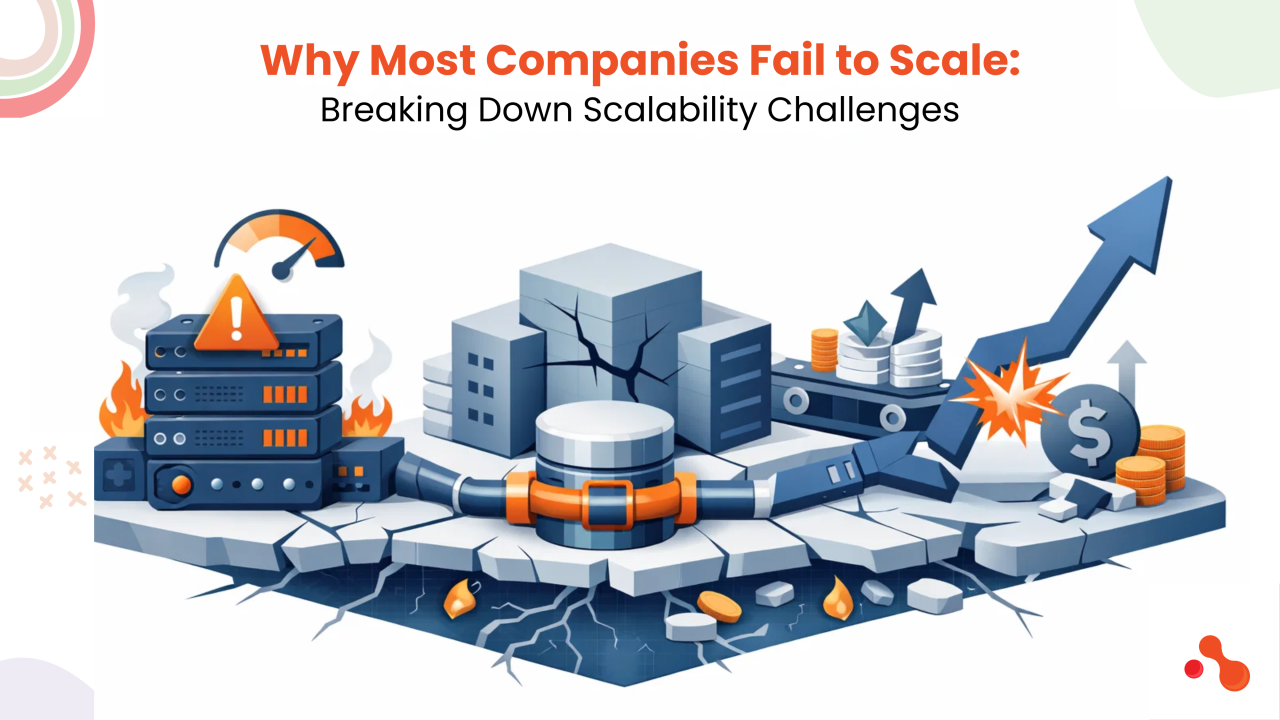
Why Most Business Software Fails to Scale With the Company
In most organizations, software decisions are made at the point of immediate need rather than long-term architectural thinking. When a system is first introduced, the primary objective is usually operational relief—removing manual effort, reducing dependency on spreadsheets, centralizing scattered data, or automating a few repetitive workflows that are slowing down day-to-day execution. At this stage, success is measured in speed of implementation rather than depth of alignment, which means almost any functional system appears acceptable as long as it solves the immediate pain. The broader question of how the system will behave under future complexity is rarely part of the decision-making framework.
However, as the organization grows, the internal structure of operations begins to shift in ways that are not reflected in the original system design. Teams expand and specialize into narrower functions, dependencies between departments increase, and decision-making begins to pass through multiple layers of approval, validation, and exception handling. Data that was once linear becomes highly relational, flowing across multiple systems and stakeholders. What was once a simple workflow gradually transforms into a network of interconnected processes that require coordination rather than just execution. At this stage, the original software starts operating in a business environment that is fundamentally different from the one it was designed for.
The critical issue is not an immediate system breakdown, but a slow and continuous misalignment between the software’s structural assumptions and the organization’s evolving reality. The system does not stop working; instead, it continues to function within its original boundaries while the business moves beyond them. This creates a growing gap where the software still executes tasks, but no longer represents the actual complexity of operations accurately. Over time, this disconnect manifests in subtle but compounding inefficiencies such as delayed decision cycles, duplicated effort across teams, inconsistent reporting structures, and increased reliance on manual validation to compensate for system limitations.
Why Initial Software Design Becomes a Constraint
Most commercially available software systems are built on generalized models of business behavior. They are designed to serve a wide range of industries and use cases, which naturally requires abstraction and standardization of workflows. This approach prioritizes ease of deployment, broad applicability, and quick onboarding over deep structural alignment with any specific organization. As a result, these systems are optimized for average use cases rather than the unique operational logic that exists within a particular business environment.
As the organization matures, these generalized assumptions begin to lose relevance. Real-world workflows become more complex, exceptions become more frequent, and operational processes start diverging across departments based on functional needs. The system, however, remains anchored to its original design boundaries, which means it cannot naturally accommodate this increasing variability. Instead of supporting evolving workflows, it begins to require external adjustments such as manual interventions, duplicated data entry, or parallel tracking mechanisms. Gradually, the software shifts from being an enabler of efficiency to a constraint that forces the organization to adapt its behavior around system limitations rather than allowing the system to adapt to the organization.

A system that cannot evolve with business complexity eventually becomes part of the constraint it was meant to solve.
Scaling Is About Complexity, Not Size
A common misconception in software strategy is that scaling is primarily defined by an increase in users, transactions, or system load. This creates a narrow technical interpretation where success is measured only through throughput metrics such as requests per second, concurrent sessions, or system uptime under pressure. While these indicators are important at an infrastructure level, they do not fully represent what actually happens inside an evolving enterprise system. In reality, most systems do not fail because they cannot handle more traffic; they fail because the structure underneath that traffic becomes increasingly difficult to manage, interpret, and coordinate as complexity grows beyond its original design assumptions.
As organizations expand, their internal structure evolves in ways that are not immediately visible at the software level. Teams become more specialized, responsibilities get distributed across multiple departments, and decision-making is no longer linear but layered across approvals, validations, and dependencies. Processes that were once simple and direct begin to branch into multiple conditional paths depending on business context. At this stage, scaling is no longer about raw performance under load—it becomes about whether the system can maintain structural coherence across fragmented but interconnected workflows. Without this coherence, the system may still operate, but the alignment between data, decisions, and execution begins to weaken progressively over time.
The Rise of Workarounds and Shadow Systems
When core systems are not designed to evolve alongside business complexity, users naturally begin developing compensatory mechanisms to keep operations moving. These are not intentional deviations but practical responses to friction. For example, when a system lacks flexibility in reporting, teams export data into spreadsheets for manipulation. When approval flows are too rigid or slow, decisions are tracked manually outside the system. When integration gaps exist between tools, information is duplicated across platforms to ensure continuity of work. Each of these actions begins as a localized solution to an immediate operational limitation rather than a systemic rejection of the core platform.
Over time, however, these isolated workarounds begin to consolidate into a parallel operational layer that runs alongside the official system. This creates a dual-reality environment where the formal system represents what *should* be happening, while external tools and manual processes represent what is *actually* happening. As this gap widens, organizations start relying on unofficial sources of truth to make decisions, reconcile data, and validate outcomes. This leads to fragmentation in reporting structures, inconsistencies in metrics, and increased dependency on human interpretation rather than system-generated clarity, ultimately weakening the reliability and trustworthiness of the entire operational ecosystem.
Why Custom Systems Handle Growth Differently
Custom software behaves differently because it is designed from the ground up based on the actual operational structure of a specific business rather than generalized assumptions about how businesses typically function. Instead of forcing organizations into predefined workflows, it begins by analyzing how decisions are made, how information flows between teams, and where operational bottlenecks naturally occur. This allows the system architecture to reflect real-world behavior rather than theoretical models, resulting in a closer alignment between how work is done and how the system supports that work.
As complexity increases, custom systems are not required to be replaced or fundamentally restructured in response to growth. Instead, they evolve incrementally through controlled modifications such as extending modules, refining workflows, or adding new integrations without disrupting existing functionality. This incremental adaptability ensures that the system remains stable while still accommodating change. Over time, this creates continuity where the system grows in parallel with the organization rather than lagging behind it, preserving operational consistency and reducing the risk of fragmentation that typically emerges in rigid, one-size-fits-all platforms.
Conclusion
Software failure in growing organizations rarely happens as an immediate breakdown or visible collapse. Instead, it occurs gradually through structural misalignment between the system and the organization it is meant to support. As the business evolves, new processes, exceptions, and dependencies emerge that were not originally accounted for in the system design. Initially, these gaps are small and manageable, but over time they accumulate into inefficiencies that become embedded within daily operations, often going unnoticed until they significantly impact performance and decision-making quality.
The true measure of a system is not how effectively it performs at the moment of implementation, but how consistently it continues to represent and support reality as that reality becomes more complex. Systems that scale successfully are not defined by their ability to simply process larger volumes of work, but by their ability to maintain clarity, structure, and alignment even as organizational complexity increases. When a system preserves this alignment, it prevents fragmentation, reduces dependency on external workarounds, and ensures that growth strengthens rather than destabilizes the operational foundation.
Leave a Reply